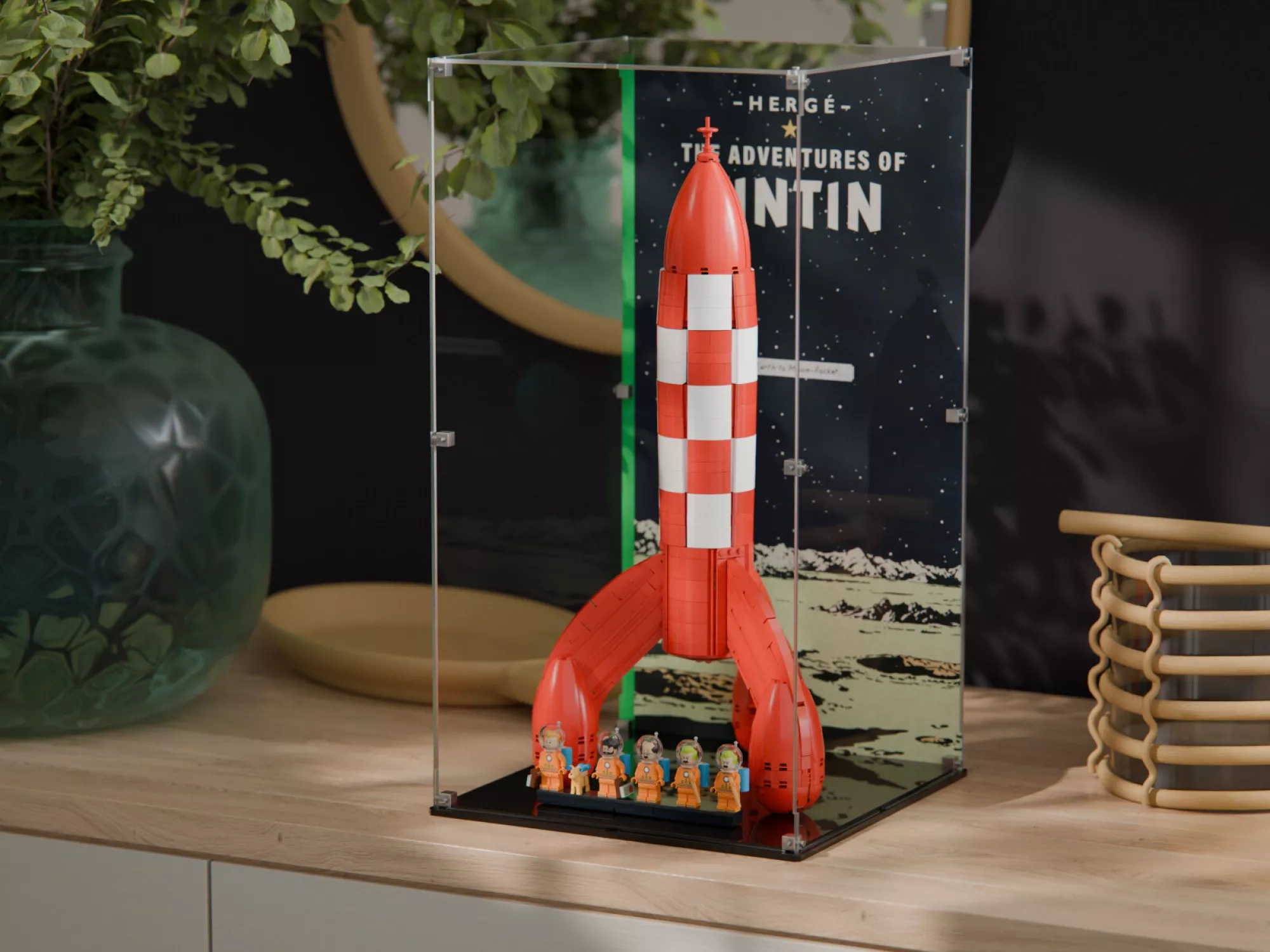
"Great snakes!" It took seventy-odd years and a lot of very patient fan campaigning to get here, but the red and white chequerboard rocket that launched a thousand childhood daydreams is an official LEGO® set. The LEGO® Tintin Moon Rocket (21367) is a 1,283 piece Ideas build, and the first time Hergé's world has been given the brick treatment.
The question, as always, is whether the set earns its £139.99. Having built it, and having lived with it on a shelf for a while since, I think the answer is a slightly complicated yes.
LEGO® Ideas Tintin® Moon Rocket (21367): the key details
| Spec | Detail |
|---|---|
| Set number | 21367 |
| Theme | LEGO® Ideas |
| Pieces | 1,283 |
| Age | 18+ |
| UK RRP | £139.99 |
| International pricing | $159.99 USD / €159.99 |
| Size | 49cm high x 20cm wide x 23cm deep |
| Minifigures | 6 (5 minifigures plus Snowy) |
| Release | 1 April 2026 |
Specs and pricing verified against LEGO.com, Brickset, Brick Fanatics, New Elementary, The Brothers Brick, Rambling Brick and Jay's Brick Blog. Minifigure moulds, sticker usage and the launch gantry decision re-checked against New Elementary, Brickset, Rambling Brick and Blocksmag, 7 September 2026.
On price: £139.99 for 1,283 pieces works out at roughly 10.9p per piece, which is steep even by LEGO® Ideas standards. You're paying for the licence and the shelf presence rather than sheer brick volume - a trade-off this whole review keeps coming back to.
The build
Eleven numbered bags, one instruction booklet, and a build that comes in at roughly two to four hours depending on how carefully you square things up. That's not long for a set at this price, and it's worth knowing going in.
Underneath the panelling there's a proper piece of engineering. The rocket is built around a Technic core with three fins set at 120 degrees, and the lower two thirds are essentially the same modular assembly repeated three times. If repetition puts you off, be warned. If you enjoy watching a shape resolve itself out of hinges and SNOT work, this is quietly satisfying stuff. The instructions do a lot of heavy lifting here, with alignment diagrams that stop you second-guessing the angles.
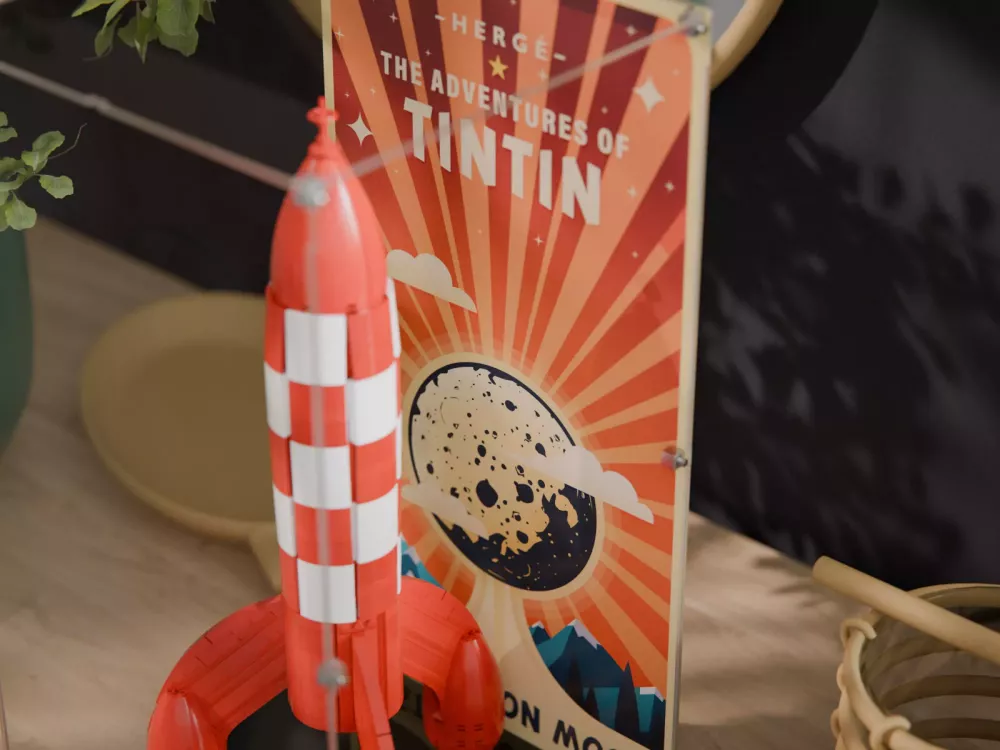
The chequerboard is where the build earns its 18+ badge. Getting the red and white panels to sit flush around a curve is fiddly - the pattern is built from dozens of individually placed red and white elements rather than one printed or stickered panel, so precision matters more than usual. The sticker sheet itself is mercifully modest: a handful of decals for the control room interior and the crew's equipment, several of them lifted straight from the artwork. They are small and detailed enough to want a steady hand and, ideally, a pair of tweezers.
Minifigures & details
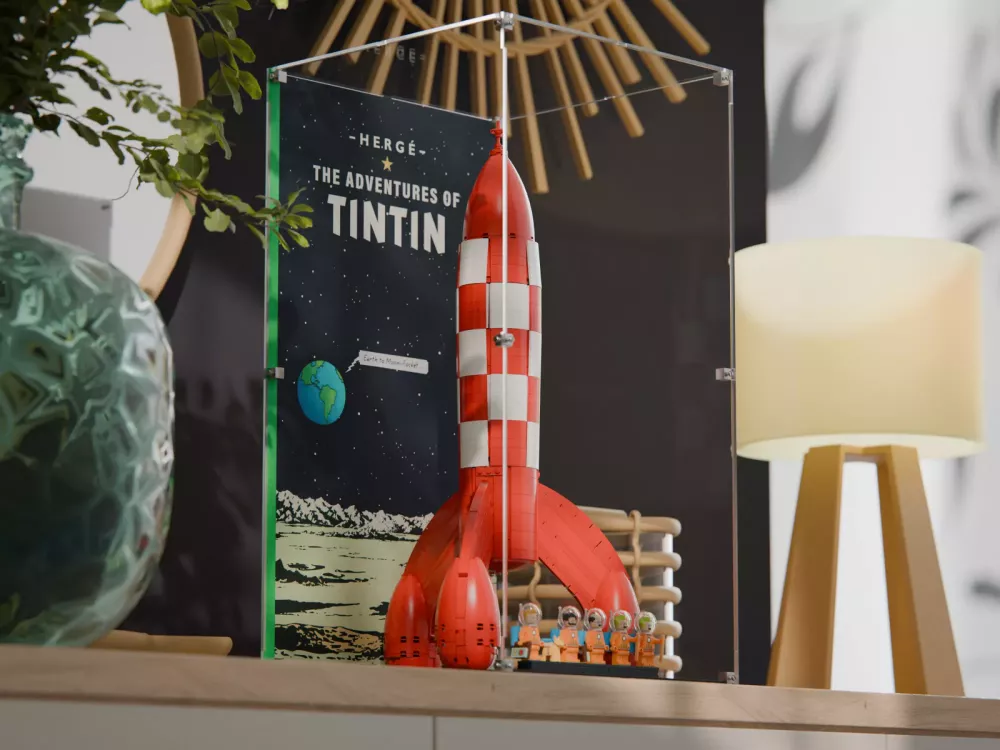
Six figures, and this is where the set really sings. Tintin, Captain Haddock, Professor Calculus and both Thomson and Thompson all arrive in matching orange pressure suits, complete with brick-built oxygen tanks and printed tubing running across the torsos.
Tintin gets a brand new hair mould for that quiff, in bright light orange. The Thom(p)sons, helmets on and bowlers left at home, get a lime green hair piece: an existing mould in a new colour, and a lovely deep cut for readers, since it nods to the Formula 14 mishap that leaves their hair growing in ridiculous colours. Snowy is a new mould too, a wire fox terrier in his own little orange spacesuit. He has no helmet, which is a curious choice for a dog standing on the lunar surface, but the designers looked at it and decided the dome element was simply too enormous to work. I'll allow it.
The faces are the clever part. LEGO® has managed to land somewhere between its own house style and Hergé's ligne claire without either winning outright, and the double-sided prints give you a second expression to play with.
Design and accuracy
Three genuinely new moulds come with the set: Tintin's quiff, the Snowy figure, and the big curved cone elements that form the nose. At 49cm tall the finished rocket has real presence, and it's the silhouette that sells it. Nose cone, three splayed fins, chequerboard livery: you could show this to someone who has never read a Tintin book and they would still know it was a rocket from an old adventure story.
Lift the panel on the nose cone and you get the control room, complete with a sticker of Earth as seen from the cabin. It's the single most iconic frame in Explorers on the Moon and it's lovely that it made the cut.
Two things nag, though. The fuselage taper is much subtler than it's on the page, so the model reads slightly more cylindrical and slightly less rocket-shaped than the source material. And the launch gantry from Alexis Dos Santos's original fan submission has been dropped entirely, which is a genuine shame. LEGO®'s reasoning is fair enough, that the tower added something like a thousand pieces and pulled focus from the icon itself, but it gave the concept scale and drama, and without it you have a very handsome rocket standing on its own three feet.
Pros and cons
| Pros | Cons |
|---|---|
| Instantly recognisable, properly imposing display piece | Roughly 10.9p per piece is steep for the size |
| Six superb figures with three new moulds | The launch gantry from the fan design was cut |
| Hidden control room with the Earth-view scene | Fiddly stickers on the interior and accessories |
| Clever Technic and SNOT engineering under the panels | Very little to do with it once it's built |
| The first ever official LEGO® Tintin set | Fuselage taper is subtler than the comics |
Display value
This is a display set, full stop. There are no play features to speak of, no opening hatches beyond the cockpit panel, and no reason to pick it up once it's finished. Which is fine, because it looks superb on a shelf.
The catch, as I have found, is that a 49cm tower of red and white panels is a dust magnet, and those angled fins are exactly the sort of geometry you don't want to be poking a cloth into. A LEGO® Tintin Moon Rocket display case is the obvious answer, and the Destination Moon backdrop option is a nice touch if you want the comic-cover look. If you would rather browse the wider range first, our LEGO display cases and cabinets cover most major sets.
A tall, narrow model like this also rewards a bit of thought about lighting. Our LEGO display lighting guide runs through how to light vertical builds without washing out the white panels, and if dust is your main worry, the guide to keeping LEGO sets dust-free is worth five minutes.
Final thoughts
The Tintin Moon Rocket isn't the most complex set in the LEGO® Ideas range, and it's certainly not the best value per brick. What it is, is the first. Seventy-plus years of one of the most recognisable images in European comics, finally rendered in a form you can put on a shelf.
If you grew up with those books, the price will bother you for about ten minutes and then stop mattering. If you're coming to it purely as a builder, it's a good but slightly short build with a spectacular payoff. And if you want a space set that gives you more to chew on, our NASA Artemis Space Launch System review is worth a read, or have a browse of the best LEGO sets for adults for something meatier.
Destination Moon. Worth the wait.
FAQ
How long does the LEGO® Tintin Moon Rocket take to build?
Most builders report between two and four hours across the eleven numbered bags, depending on how much care goes into aligning the chequerboard panels.
How tall is the LEGO® Tintin Moon Rocket?
The finished model stands 49cm tall, 20cm wide and 23cm deep, so it needs a decent amount of vertical shelf space.
How many minifigures come with set 21367?
Six figures in the box: five minifigures - Tintin, Captain Haddock, Professor Calculus, Thomson and Thompson - plus an all-new Snowy dog element in his own spacesuit.
Is the Tintin Moon Rocket worth the money?
At £139.99 for 1,283 pieces it's expensive per brick. As a licensed first-of-its-kind display piece with six exclusive figures, most Tintin fans will decide it's worth it anyway.